
Why do cats prefer certain people?
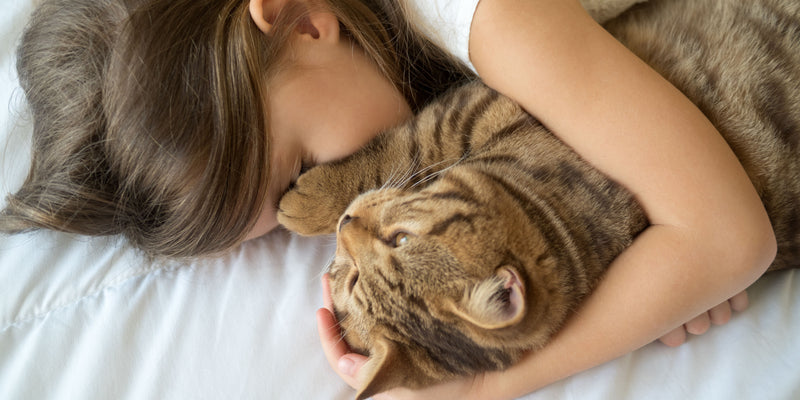
Cats prefer certain people because those people respect their needs. Lack of forced contact, respect for their signals, and a calm tone are favored by felines. Being the human who feeds them is not always enough! Discover why a cat might choose you, specifically, in a room full of people.
In short:
- Cats prefer certain people who respect their signals and their space.
- The less you insist, the less you represent a constraint, and the more likely they are to approach you.
- Your cat recognizes you first by your scent, before sight or hearing.
- To be loved by your feline: feeding them strengthens your bond but is less important than respecting their signals.
- Being calm and introverted increases your chances of being a person loved by cats.
Why does a cat choose us?
A cat chooses you when they sense that you respect their rhythm, not just because you are calm. Your furball communicates with you: their ears, tail position, or gaze constantly tell you whether they are available for contact or prefer to keep their distance.
Example: a cat that pulls its head back or moves away during a pet is asking you to stop. Continuing despite this signal erodes the trust they place in you, even if your initial intention is affectionate.
Be careful, respecting your feline's signals does not mean being submissive to your cat! It's more about showing them that you understand them, that you consider them a living being, an individual in their own right, with their own needs and limits. Let them come to you when they want to!
According to the study Attachment bonds between domestic cats and humans by Kristyn Vitale, a researcher at Oregon State University, published in September 2019 in Current Biology, the attachment style of cats to their humans is comparable to that observed in dogs and young children.
In this study, 65% of the cats and kittens tested showed a "secure" attachment, meaning an ability to feel secure with their primary human and then explore their environment more calmly once this security was established. This rate is almost identical to that observed in human infants.
Why do cats prefer people who ignore them?
A cat more easily approaches a person who does not directly solicit them. This behavior is not mysterious: the less you insist, the less you represent a constraint in their eyes.
You can use this principle to tame a wary cat, by following a few steps:
- Show that you have seen your cat, without calling them or staring at them.
- Let them come to you, without reaching out first.
- Offer a brief pet on the areas they enjoy (chin, cheeks, back), then stop on your own.
- Resume a neutral activity, as if nothing happened.
This alternation between attention and withdrawal piques their curiosity. A cat that is never directly solicited feels freer to make the first move. If they enjoy your pets, they will send you signals to ask you to continue!
Does a cat recognize a person by smell?
Your cat recognizes you first by your scent, even before seeing or hearing you. It is their most reliable sense for distinguishing a familiar person from a stranger.
According to the study Behavioral responses of domestic cats to human odor by Yutaro Miyairi and his team from Tokyo University of Agriculture, published on May 28, 2025, in PLOS One, cats sniff the scent of a stranger longer than that of their owner. This result confirms that your cat identifies you very quickly thanks to your scent!
This quick recognition explains why a cat sometimes seems to ignore you when you come home. It's not indifference, but immediate recognition that doesn't require further verification.
The cat's acute sense of smell also explains why cats more easily accept people who already frequent other cats. Smelling a familiar feline scent can reassure a cat about your intentions. See it as a silent recommendation or a safety signal.
Do cats prefer the people who feed them?
Food plays a real role in a cat's attachment, but it is generally not the main factor.
A cat naturally associates the person who feeds them with a pleasant and secure moment. This association works just as well with a meal as with a treat given at the right time, for example after a game or a shared moment of calm. It's a good tool to strengthen a bond!
📌 Strengthening the bond without making your cat gain weight
Give your cat treats adapted to their carnivorous diet. At Tomojo, Moush treats are formulated by veterinarians, made from insects, and meet your furball's nutritional needs.
Worried about the risk of overweight? Discover our guide to know if your cat is overweight.
What type of person attracts cats?
Professor Denise D. Guastello conducted the study Personality Differences between Dog People and Cat People at Carroll University, on a sample of 417 students in 2017.
The results show that people who identify more as "cat people" than "dog people" are generally:
- Introverted
- Open-minded
- Sensitive
- Non-conformist
This is therefore a combination of several traits that reassure a cat:
| Personality Trait | How it works in your favor |
|---|---|
| Introversion | You solicit the cat less, they feel less observed |
| Calm | Your presence is predictable, therefore reassuring |
| Patience | You let the cat come to you at their own pace |
| Sensitivity | You are quicker to spot their signs of discomfort |
| Non-conformity | You do not impose rigid rules of contact |
Cat's preference for a person: the chosen one syndrome
The chosen one syndrome refers to that moment when, in a room full of people, a rather wary cat spontaneously approaches only one person! This cat, whom no one usually manages to approach, precisely chooses the one who was not seeking contact.
Many pet owners have an anecdote of this type to tell. During a visit to friends who own one or more cats, it is common to see that the cat difficult to approach decides to come and rub against the person who was not soliciting them, or who had not even seen them.
This phenomenon is explained because the person is not seeking contact. They send calm and non-threatening signals, exactly what a wary cat is looking for. There's nothing mystical about it; it's more a question of posture and attitude.
The same principle explains certain situations experienced in relationships. The cat does not necessarily favor the person who manages the litter box, takes them to the vet, or feeds them. On the contrary, they may turn to the one who imposes the fewest daily constraints on them.
⚠️ ATTENTION these observations remain behavioral tendencies, not a universal rule! Some cats, on the other hand, will go towards the most demonstrative person, regardless of what has just been described. Every cat is different: an individual in their own right with their character, experiences, and emotions.
What are the signs that prove your cat loves you?
Here are the signals that show your cat loves you:
| Sign | What it means |
|---|---|
| Slow blinking of eyes | A signal of trust and relaxation, also called the "cat kiss" |
| Purring in your presence | A state of well-being associated with your presence |
| Head or flanks rubbed against you | Your cat deposits pheromones to integrate you into their territory |
| Belly exposed | Your cat shows vulnerability, a sign of trust |
| Tail held vertically | Shows a friendly and confident greeting |
Frequently asked questions about cat preferences
Why does my cat prefer someone else over me?
Respect for cat signals explains why a cat prefers certain people. If another person in the household solicits your cat less or better respects their rhythm, they may naturally approach that person first.
Why do cats prefer people who ignore them?
A person who does not directly solicit the cat appears less threatening in their eyes. This mechanism sometimes leads a cat towards the most discreet person in the room.
Do cats recognize their owner by smell?
Yes, cats recognize their owner primarily by smell, as shown in Yutaro Miyairi's study (2025). It is their most reliable sense for identifying a familiar person.
Does attracting cats have spiritual significance?
No, no serious study confirms any spiritual significance for cats preferring certain people. However, cats do hold a special status in certain religions. For example, in Islam, they are considered a pure animal (tahir): their contact does not soil water or clothing, unlike other animals. The cat's place is supported by several hadiths (narratives reporting the actions and words of the Prophet Muhammad), including that of the companion Abu Hurairah, nicknamed "father of the kitten" for his attachment to these animals.